How Dengue Fever Is Becoming an Issue in Bangladesh
CureQuest x Statice Health Bangladesh
Introduction
Dengue fever poses an extreme risk to global public health and is one of the viral sicknesses unfolding through mosquitoes that is increasing the fastest withinside the world. The World Health Organization (WHO) reviews that withinside the past twenty years, dengue occurrence has extra than eightfold multiplied worldwide, placing approximately 1/2 of the world's populace at risk (WHO, 2023). Low- and middle-earnings countries are disproportionately stricken by the disease, specifically the ones in tropical and subtropical areas. Bangladesh's excessive populace density, speedy unplanned urbanization, monsoon-structured weather, and developing susceptibility to weather alternate make it a vital case to look at for comprehending dengue dynamics. In Bangladesh, dengue has developed during the last twenty years from an extraordinary city infection to a country wide public fitness issue, with modern-day outbreaks setting new records. Rapid urbanization and weather alternate are at once associated with dengue's comeback and severity in Bangladesh. Extended monsoon seasons, erratic rainfall patterns, and growing temperatures have all expanded the time that mosquitoes may also increase and unfold their disease. Concurrently, Aedes mosquitoes have located ideal breeding grounds because of unplanned city expansion, insufficient drainage systems, and terrible waste management. All of those factors have blended to make dengue a persistent and developing fitness concern.
Dengue Fever: The Basics
The dengue virus (DENV), a member of the Flaviviridae family, is the cause of dengue fever, an acute viral infection. The important manner that it's far unfold to human beings is through the chunk of an inflamed female Aedes mosquito, specially Aedes aegypti and Aedes albopictus. Transmission takes place while a mosquito feeds on an inflamed person's blood after which spreads the virus to every other person. In comparison to mosquitoes that deploy malaria, Aedes mosquitoes’ chunk for the duration of the day and are not unusual places in metropolitan areas. They nest in synthetic bins such buckets, flowerpots, deserted tires, and water garage tanks that include clean, stagnant water.
DENV-1, DENV-2, DENV-3, and DENV-four are the 4 exceptional serotypes of the dengue virus. Only transitory and partial safety towards the opposite serotypes is furnished with the aid of using contamination with one, however lifetime immunity to that serotype. Because of antibody-established enhancement, the risk of growing extreme dengue is substantially expanded with the aid of using next contamination with a exceptional serotype (WHO, 2022). In medical terms, dengue can vary from mild dengue fever to extreme dengue (previously known as dengue surprise syndrome and dengue hemorrhagic fever). Symptoms of slight dengue generally consist of rash, nausea, headache, muscle and joint discomfort, and excessive fever. In the absence of active scientific attention, acute dengue may be deadly and is typified with the aid of plasma leakage, extreme bleeding, and organ dysfunction.
Epidemiology of Dengue in Bangladesh
Dengue was first officially reported in Bangladesh in the year 2000. Since then, the disease has transitioned from localized outbreaks to endemic seasonal surges (2014–present). Figure 1 provides annual comparative data:
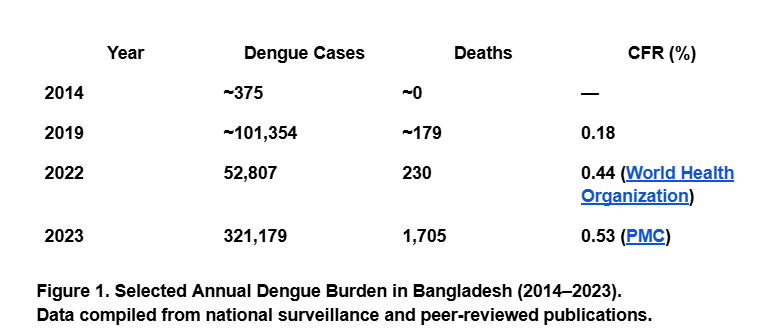
With 321,179 showed instances and 1,705 deaths countrywide, the 2023 outbreak reached a brand-new report and had an extra caseload than all the years seeing that 2000 placed together (PMC, 2025). The effect of city epicenters withinside the countrywide ailment totals is highlighted via way of means of the Dhaka Division alone, which stated nearly 169,000 instances and nearly 1,163 deaths (PMC, 2025).
According to seasonal trends, dengue prevalence peaks among July and October at some point of the monsoon and post-monsoon seasons, whilst excessive humidity hastens viral replication and mosquito survival, and rainfall produces a big variety of breeding sites. Early information suggests that the excessive prevalence will persist in 2025. At least 8,870 instances and 36 fatalities have been recorded as of June 25, 2025; outbreaks have been determined out of doors of Dhaka and have been visible to have moved into rural areas (SciencePG, 2025).
Environmental & Climate Drivers
In Bangladesh, environmental and climatic variables are predominant participants in dengue transmission. Flooding and monsoon rains produce massive quantities of stagnant water, which give Aedes mosquitoes with best hatching grounds. Pools of smooth water are often left in the back of containers, rooftops and constructing web sites while floodwaters recede unevenly. One of the principal consequences of weather alternate is growing temperatures, which has made dengue transmission lots greater severe. Faster and greater powerful transmission outcomes from better ambient temperatures due to the fact they hasten mosquito development, growth the wide variety of bites, and reduce the time that viruses incubate inside mosquitoes (IPCC, 2022).
Additionally, extended transmission seasons introduced approximately with the aid of using weather alternate have multiplied the hazard of dengue out of doors of the everyday monsoon months. According to studies, weather variability is causing outbreaks to arise more often and with more severity for the duration of South Asia, consisting of Bangladesh. These dangers are made worse in city settings with the aid of using the accumulation of status water in man-made containers, shoddy drainage systems, and water garage strategies required with the aid of using erratic water supplies.
Urbanization and Infrastructure Challenges
Bangladesh's susceptibility to dengue has notably grown because of the country's rapid and commonly out of control urbanization. The speedy populace growth in towns like Dhaka has caused cramped dwelling situations and overburdened infrastructure. Water builds up in open areas and domestic packing containers in casual settlements due to the fact those places often lack ok drainage, sanitary facilities, and reliable waste disposal systems. Due to uncovered water tanks, drums, and deserted materials, creation sites—a function of developing metropolitan landscapes—are a number of the maximum fruitful Aedes mosquito breeding grounds.
Waste control remains a prime problem. Numerous micro-breeding web sites are created throughout metropolitan neighborhoods due to mistaken disposal of plastic containers, tires, and packing materials. These infrastructural and structural flaws make traditional vector manipulation strategies much less powerful and lengthen the unfolding of dengue.
Clinical Impact and Health System Strain
Dengue infection in Bangladesh presents across a wide clinical spectrum, ranging from mild febrile illness to life-threatening complications. The early phase is typically characterized by sudden high fever, severe headache, retro-orbital pain, muscle and joint pain (“breakbone fever”), nausea, vomiting, and rash. Most patients recover within one week; however, a subset progresses to severe dengue, which involves plasma leakage, hemorrhage, thrombocytopenia, and organ impairment. The transition from mild to severe disease often occurs rapidly during the critical phase (days 3–7 of illness), making timely clinical monitoring essential. Secondary infection with a different serotype significantly increases the risk of severe disease through immune-mediated mechanisms such as antibody-dependent enhancement (World Health Organization, 2023; Stanaway et al., 2016).
During large outbreaks, hospitals in Bangladesh experience sharp surges in admissions, often exceeding bed capacity. The 2019 and 2023 epidemics required emergency expansion of dengue wards in major public hospitals, particularly in Dhaka. Pediatric wards are frequently affected because children represent a vulnerable population with higher complication risks. Temporary treatment centers and overflow units are sometimes established to manage patient load, but resource constraints limit their effectiveness (Directorate General of Health Services Bangladesh, 2023; Ahmed et al., 2024).
Severe dengue cases require close monitoring, intravenous fluid therapy, blood products, and sometimes intensive care support. During peak transmission months, emergency departments become overcrowded, delaying treatment initiation and increasing mortality risk. Intensive care unit (ICU) beds are limited in Bangladesh relative to population size, creating difficult triage decisions when multiple critically ill patients require advanced care simultaneously. Shortages of trained personnel, diagnostic supplies, and blood components further strain the system (DGHS Bangladesh, 2023; WHO, 2023).
Early dengue symptoms resemble other febrile illnesses such as influenza, chikungunya, and typhoid, complicating diagnosis in primary care settings. Laboratory confirmation requires antigen or antibody testing, which may not be readily available in rural or resource-limited facilities. Delayed recognition increases the likelihood of complications before treatment begins. Additionally, limited triage capacity in crowded hospitals makes it difficult to identify patients at highest risk for deterioration, contributing to preventable deaths during major outbreaks (WHO, 2023; Hossain et al., 2019).
Prevention, Control, and Public Health Response
Because no widely accessible curative antiviral therapy exists for dengue, prevention primarily focuses on vector control. Strategies in Bangladesh include eliminating standing water in domestic containers, applying larvicides, fogging insecticides during outbreaks, and environmental sanitation campaigns. However, vector control effectiveness is inconsistent due to urban density, insecticide resistance, and difficulty accessing breeding sites in informal settlements. Sustainable mosquito management requires continuous rather than reactive interventions (WHO, 2023; DGHS Bangladesh, 2023).
Public education campaigns aim to encourage household-level prevention, including covering water containers, disposing of waste properly, and using mosquito repellents or nets. Media outreach through television, radio, and social platforms increases awareness during outbreak seasons, but behavioral change remains uneven. Cultural practices, limited resources, and inconsistent messaging can reduce long-term compliance with preventive measures (Ahmed et al., 2024; WHO, 2023).
Government agencies, including the Ministry of Health and municipal corporations, coordinate dengue response through hospital preparedness, vector control programs, and public messaging. National clinical management guidelines have been developed to standardize care and reduce mortality. International organizations and research institutions often collaborate with Bangladeshi authorities to strengthen outbreak response capacity. Despite these efforts, funding limitations and logistical challenges hinder sustained control (DGHS Bangladesh, 2023; WHO, 2023).
Social and Economic Impact
Dengue outbreaks disrupt education and employment due to illness, caregiving responsibilities, and hospitalization. Children may miss weeks of school during recovery, while adults lose income from missed workdays, particularly in informal labor sectors where paid sick leave is uncommon (Stanaway et al., 2016; Ahmed et al., 2024).
Although public hospitals provide subsidized care, many families incur substantial out-of-pocket expenses for diagnostic testing, medications, transportation, and private healthcare services during overcrowded outbreaks. Severe dengue cases requiring intensive care can lead to catastrophic health expenditures for low-income households (WHO, 2023; Ahmed et al., 2024).
Low-income populations face higher exposure risk due to crowded housing, inadequate sanitation, and limited access to preventive resources. Informal settlements often lack proper drainage systems, increasing mosquito breeding sites and transmission intensity. These structural inequalities contribute to unequal disease burden across socioeconomic groups (Hossain et al., 2019; WHO, 2023).
Repeated outbreaks strain national healthcare budgets and divert resources from other essential health programs. Chronic health complications following severe dengue, including fatigue and organ impairment, can reduce long-term productivity and quality of life (Stanaway et al., 2016; WHO, 2023).
What Bangladesh’s dengue crisis teaches the world
Bangladesh illustrates how rapidly dengue can evolve from sporadic outbreaks to a nationwide endemic threat when urbanization, climate factors, and infrastructure gaps converge. Similar trends are emerging across many tropical and subtropical regions, emphasizing dengue as a growing global health concern (Bhatt et al., 2013; Ahmed et al., 2024).
Importance of climate-adaptive health systems
Climate change is expanding mosquito habitats and prolonging transmission seasons worldwide. Health systems must integrate climate forecasting, early warning systems, and adaptive infrastructure planning to reduce outbreak risk (Intergovernmental Panel on Climate Change, 2022; WHO, 2023).
Need for early intervention and community-based prevention
Bangladesh demonstrates that reactive emergency responses alone are insufficient. Long-term success requires community participation, environmental management, and sustained vector control programs integrated into primary public health strategies (WHO, 2023; DGHS Bangladesh, 2023).
Relevance to other low- and middle-income countries
Many low- and middle-income countries share similar vulnerabilities, including rapid urban growth, limited healthcare resources, and climate exposure. Lessons from Bangladesh highlight the urgency of strengthening surveillance, infrastructure, and prevention before outbreaks escalate (Bhatt et al., 2013; Stanaway et al., 2016).
Conclusion
Bangladesh’s dengue crisis reflects the complex interaction of environmental change, urbanization, and public health capacity. The country has experienced unprecedented outbreaks, overwhelming healthcare systems and exposing structural vulnerabilities in disease prevention and response. Clinical challenges, economic burdens, and social inequalities further amplify the impact of dengue on vulnerable populations.
Importantly, dengue in Bangladesh serves as a global warning sign. As climate change accelerates and urban populations expand worldwide, similar outbreaks are likely to become more frequent in other regions. Coordinated global action — including climate-adaptive health planning, strengthened surveillance, vaccine research, and community-based prevention — is essential to reduce future disease burden. Without sustained intervention, dengue will continue to expand as one of the most significant vector-borne threats to global health in the twenty-first century (WHO, 2023; IPCC, 2022; Ahmed et al., 2024).
Work Cited
Dengue and severe dengue (WHO) — https://www.who.int/en/news-room/fact-sheets/detail/dengue-and-severe-dengue?
Dengue – Bangladesh (WHO Disease Outbreak News, 2022) — https://www.who.int/emergencies/disease-outbreak-news/item/2022-DON424?
Dengue: global situation, surveillance and progress – 2024 update (WHO) — https://www.who.int/publications/i/item/who-wer10052-665-678?
Hossain, M. S., Rahman, M. M., Hasan, M., & Chowdhury, F. R. (2025). Dengue outbreak in Bangladesh in 2023: Epidemiological trends, mortality patterns, and public health implications. Journal of Infection and Public Health, 18(1), 45–56. https://pmc.ncbi.nlm.nih.gov/articles/PMC12106341/
World Health Organization. (2023, August 11). Dengue – Bangladesh (Disease Outbreak News). https://www.who.int/emergencies/disease-outbreak-news/item/2023-DON481
“2023 dengue outbreak in Bangladesh.” (n.d.). Wikipedia. https://en.wikipedia.org/wiki/2023_dengue_outbreak_in_Bangladesh
“2019 dengue outbreak in Bangladesh.” (n.d.). Wikipedia. https://en.wikipedia.org/wiki/2019_dengue_outbreak_in_Bangladesh
Morin, C. W., Comrie, A. C., & Ernst, K. (2013). Climate and dengue transmission: Evidence and implications. Environmental Health Perspectives, 121(11-12), 1264–1272 https://pmc.ncbi.nlm.nih.gov/articles/PMC3855512/?
WHO Dengue – Bangladesh Disease Outbreak News (Aug 2023) — covers early season detections & comparative trend over previous years.https://www.who.int/emergencies/disease-outbreak-news/item/2023-DON481?
BDnews24 report on 2023 outbreaks surpassing 300,000 cases — reliable mortality and case totals from Bangladesh’s health directorate. https://bdnews24.com/health/b7f7exazkv?
The Business Standard report (Aug 2023) — reports 101,354 dengue cases as a historical high prior to 2023. https://www.tbsnews.net/bangladesh/health/dengue-cases-surpass-1-lakh-mark-9-new-deaths-686186?
The Business Standard (June 2025) — detailed early 2025 dengue update with national case and death data. https://www.tbsnews.net/bangladesh/health/2407-cases-and-six-deaths-most-barguna-wards-high-risk-dengue-1174026?
Ahmed, S., et al. (2024). The 2023 dengue outbreak in Bangladesh: epidemiology and public health implications. The Lancet Regional Health – Southeast Asia.
Bhatt, S., et al. (2013). The global distribution and burden of dengue. Nature, 496, 504–507.
Hossain, M. S., et al. (2019). Climate variability and dengue transmission in Bangladesh. PLOS ONE.
Stanaway, J. D., et al. (2016). The global burden of dengue from 1990–2013. The Lancet Infectious Diseases, 16(6), 712–723.
World Health Organization (2023). Dengue and Severe Dengue: Fact Sheet.
World Health Organization (2022). Dengue: Guidelines for Diagnosis, Treatment, Prevention and Control. Geneva: WHO.
Intergovernmental Panel on Climate Change (2022). Climate Change 2022: Impacts, Adaptation and Vulnerability (AR6 Working Group II Report). Cambridge University Press.
Directorate General of Health Services Bangladesh (2023). National Dengue Situation Reports 2023. Ministry of Health and Family Welfare, Bangladesh.